
An undersized generator dips, stalls and trips breakers every time a big motor starts; an oversized one wastes capital and “wet-stacks” when it runs lightly for long periods. Getting the size right is simply a matter of matching the set to the real load, the real start-up transients and the real site conditions. Here is how to work through it.
1. Learn to read the nameplate
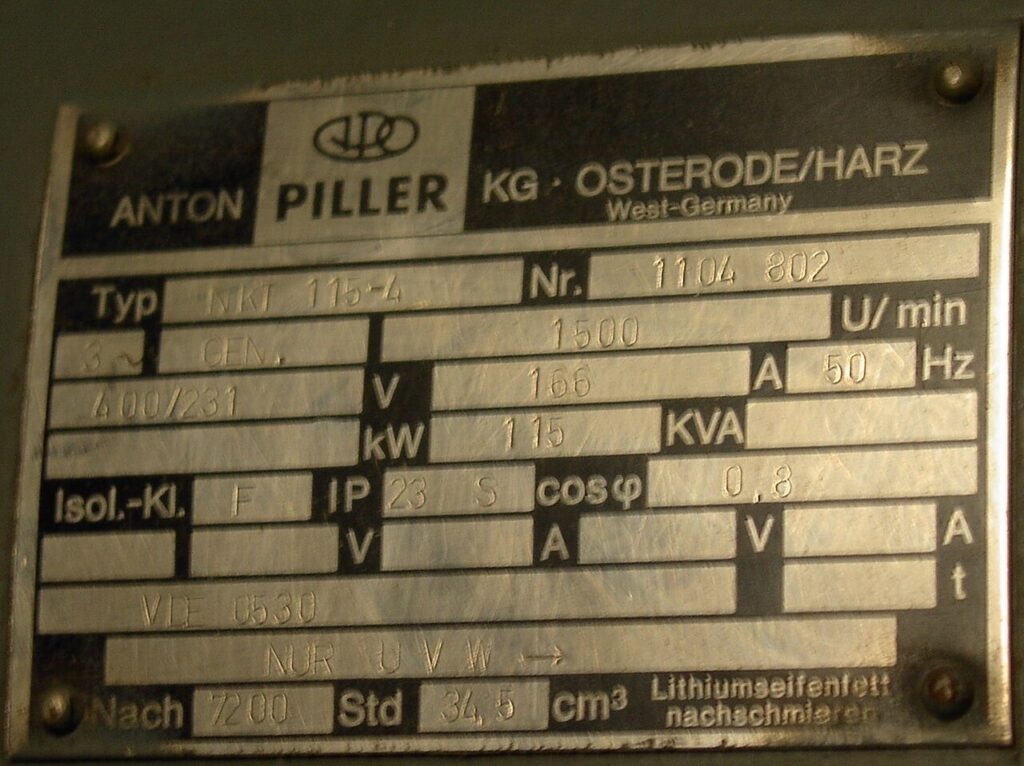
The rating plate tells you the machine’s designed limits. Two numbers matter most: kW, the actual power delivered, and kVA, the apparent power the alternator must produce. They are linked by the power factor: kW = kVA × cosφ. A typical industrial plate — like the one pictured — shows 400/231 V, 50 Hz, 1500 rpm, a power factor of 0.8, and the matching kW and kVA. Sizing always ends by converting your kW load back into the kVA the generator must supply.
2. Pick the right duty rating (ISO 8528)
- Standby Power (ESP) — backup for outages only, a few hundred hours a year, no overload allowed.
- Prime Power (PRP) — power for a variable load over long running hours; allows short overload. Most continuous or frequent-use sites.
- Continuous Power (COP) — constant base-load, such as grid paralleling.
- Limited-Time Power (LTP) — capped hours per year for occasional use.
3. Inventory the connected load and apply diversity
List every circuit and motor with its kW, then apply a diversity (demand) factor — the realistic assumption that not everything runs at full power at the same time. The sum of running loads after diversity, not the sum of every nameplate, is your starting figure.
4. Account for motor starting inrush
This is where most sizing mistakes happen. A direct-on-line (DOL) motor can draw five to six times its running current for a few seconds, and that transient — not the steady load — often dictates the set size. Large motors are worth starting with star-delta, soft-starters or VFDs to cut the surge and let you specify a smaller, cheaper generator.
5. Convert to kVA and add the transient
- Total running kW ÷ power factor = running kVA.
- Add the extra kVA needed to start the largest motor (running kVA of that motor × (inrush ratio − 1)).
- The larger of these is your target apparent power.
6. Derate for altitude and temperature
Air gets thinner as you go up and engines breathe less; high ambient heat hurts cooling output. As a rule of thumb derate roughly 3% of output per 300 m of altitude and a few percent for sustained high temperature. A set that fits on paper at sea level may be too small on a hot, elevated site.
7. Leave a sensible margin
Aim to run the generator between about 30% and 80% of its prime rating, and leave headroom for future load. Below roughly 30% for long stretches, unburnt fuel accumulates on exhaust and engine internals — the wet-stacking that damages lightly-loaded sets.
A quick worked example
Connected load 160 kW; diversity 0.8 gives 128 kW running. At power factor 0.8 that is 160 kVA. The largest motor is 30 kW DOL, whose starting surge pushes the transient above the running figure, so the set is chosen around 200 kVA prime — then derated for the site’s altitude and temperature.
Takeaway
Correct sizing balances three things: the running load, the start-up transients, and the environment. Work them in that order and you get a set that starts cleanly, runs efficiently and lasts. Higenset’s engineers are happy to review your load list and confirm a sizing before you specify.
Need a Generator Quote?
Talk to Higenset’s engineers about sizing, pricing, and shipping to your site.
Request a Quote